

Basics
Private Sector vs. Public Sector Employment
Private sector employers can discharge an employe for a good reason, a bad reason, or any reason at all, as long as it is NOT done for an illegal purpose (e.g., discrimination, retaliation, etc.). In contrast, public sector employers, as the the County of Riverside, must have "just cause" to administer discipline to their permanent/regular/otherwise eligible employees.
What is required for "Just Cause"?
The concept of Just Cause requires that the County establish it had a rational and legally defensible basis for the disciplinary action taken against its employee. the best defense in proving just cause is the ability to demonstrate the following three things:
- The employee was made aware of expectations and/or policies and procedures (i.e. put "on notice")
- He/she knew that the conduct/level of performance was unacceptable and if continued, could lead to formal discipline
- He/she was provided an opportunity to correct conduct/perfomance
What is Due Process?
Due process is the concept that before you take something away from a person, you give them notice and an opportunity to respond. Once a County employee completes his/her probationary period, he/she has property rights to their position, and a reasonable expectation of continued employment. County employees who met this criteria, have the right to challenge discipline imposed by the County. It is important that there be clear expectations for behavior and job performance, consistency in appliction of discipline, and evidentiary support for the disciplinary decision. Accordingly, certain steps must be followed to ensure regular, full-time employees are afforded their "due process" rights. The County must address employee performance/conduct issues at the lowest possible level; this is accomplished through the practice of progressive discipline.
Elements of Progressive Discipline
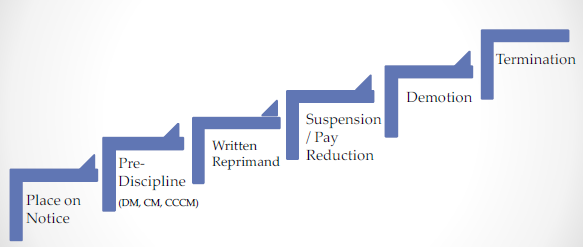
Where does Progressive Discipline start?
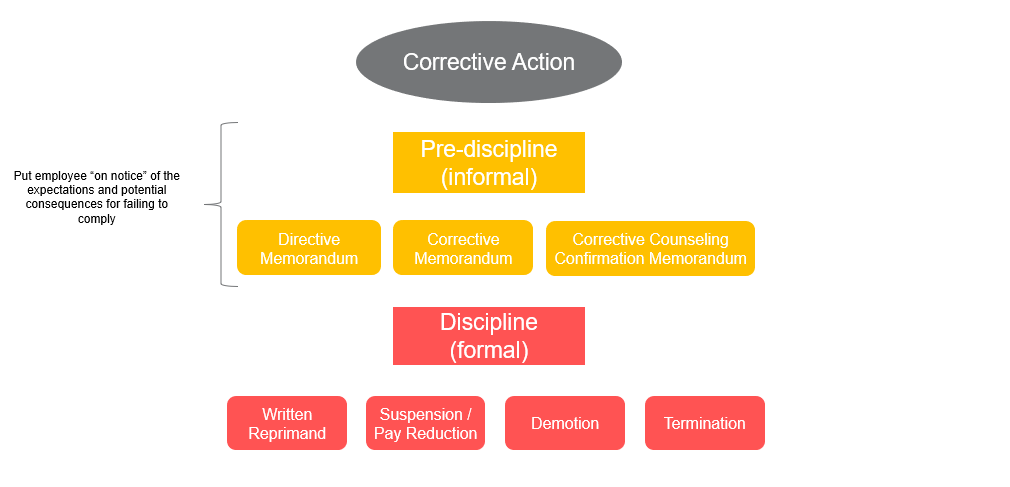
Pre-discipline is the beginning of the Progressive Discipline sequence. Pre-discipline is informal, NOT appealable, and can take the form of either verbal counseling or a written memorandum. It is the opportunity to recognize poor performance or misconduct in its earliest stages and take corrective action quickly and easily BEFORE the performance/conduct rises to the level of formal discipline. It often is all that is needed to correct the behavior/performance and get the employee back on track. Pre-discipline often establishes the basis for “Just Cause.”
Are there any groups that are excluded from following the standard corrective action, and follow a different form of action?
Yes. Law enforcement, probationary employees, at-will employees, temporary/per diem employees.
How is pre-discipline handled?
Pre-discipline is handled informally through the following written memorandums (in order of severity):
Directive Memorandum (DM)
- When you need to direct someone to do something OR not do something
- Can be issued to an individual or group
Corrective Memorandum (CM)
- When you need to correct someones behavior
- Memo should contrast observed behavior with desired behavior
- Employee has already been put on notice or made aware of expectations
- Includes statement that "future instances MAY result in formal discipline
Corrective Counseling Confirmation Memorandum (CCCM)
- When you need to memorialize a formal verbal counseling
- Should outline expectations going forward and potential consequences for failure to meet them
- Includes statement that future instances WILL result in formal disclipline
The incident or specific conduct that needs to be improved (ex: attendance, discourteous conduct, failing to complete a task, etc.)
Specific details surrounding the incident or specific conduct (ex: what happened, date, time, location, witnesses; number of occurrences – late 5 times in the past week; yelling, name calling, etc.)
Why the incident or specific conduct was inappropriate or needs to be remedied (ex: impact - negatively impacts morale, disrupted operations, work reassignments, patient care was delayed, etc.)
Prior conversations with the employee about the problem/issue and expectations (ex: when was the employee put “on notice”)
Management’s expectation(s) going forward (ex: you are required to make contact with the Physicians…)
What will happen if the employee does comply with the expectations in the future (ex: Failure to comply will be considered a violation of this directive and may be subject to discipline.)
Which memo do I use?
The memos are designed to be issued in order of severity (i.e. DM CM CCCM). However, they are not required to be used in succession (i.e. you don’t have to start with a DM; you can go straight to a CM or even a CCCM if the situation calls for that level of action).
Evaluate each situation on a case-by-case basis by considering the severity, frequency, impact, and history.
Examples of conduct that may result in informal, pre-discipline action, via DM, CM or CCCM:
- Attendance; absenteeism/tardiness; sick leave abuse
- Poor work quality/ task performance
- Failure to comply with Department/County policies (see specific Board Policies below that typically result in formal discipline)
- Rude or discourteous treatment/conduct
- Poor attitude
Examples of conduct that might result in formal, more increased level of discipline, and require HR involvement:
- Harassment, Discrimination or Retaliation (Board Policy C-25)
- Under the Influence (Board Policy C-10)
- Fighting, work place violence or serious threat (Board Policy C-27)
- Dishonesty
- Stealing
- Flagrant insubordination (employee not doing what they are told, particularly if they are told what the consequence will be)
- Continued absences, tardiness, conduct, or poor performance after other less severe forms of discipline have already been utilized
Does the employee need to sign the memo?
No. The memo should contain a signature line and date for the employee to complete, however, their signature is just an acknowledgment of receipt and does not necessarily signify the employee’s agreement with its content. If the employee refuses to sign, please note “Employee refused to sign” and include your initials and the date.
If employee refuses to sign, it’s recommended that you email him/her a copy for their records as documentation.
Is there any other information I should note on the memo after meeting with the employee?
If the employee mentions the need for a leave during your conversation, or personal challenges that are hindering their performance or causing them to “act out,” provide them a copy of the appropriate paperwork (see below) and note on the memo accordingly
- I have informed the employee of the Family & Medical Leave Act (FMLA)
Request for Family/Medical Leave
- I have informed the employee of Employee Assistance Services (EAS)
EAS Brochure
- I have informed the employee of Workers Compensation (i.e. injury on the job)
Workers Compensation Website - http://workcomp.rc-hr.com/FILEACLAIM.aspx
Supervisor Injury Check List
- I have informed the employee of Workers Compensation (i.e. injury on the job)
I have informed the employee of the Disability Access Office (i.e. reasonable accommodation)
DAO website - http://dao.rc-hr.com/
Employee Rights & Responsibilities
What do I do after issuing the memo?
1) Provide the employee a copy
2) Maintain a signed copy in your supervisor’s file
- one year from date of issuance, can be used for progressive disciplinary purposes
3) Send a copy to Employee Relations via e-mail at [email protected]
Can my employee appeal a pre-disciplinary memo?
No, informal corrective action (pre-discipline) is not appealable.
What is a probationary period and how do I know if my employee is still on one?
The probationary period is an extension of the hiring process. Probationary periods allow you, as the manager, to determine whether your employee possesses the skills and abilities to perform their job. Your expectations should be made clear on day one and every day of the probationary period. If the employee exhibits a problem with attendance or conduct during their probationary period, after being put on notice of the expectations, the employee should be released. Do not settle for mediocrity. Do not wait until the last minute.
If your employee is new to the County, they would be serving an initial probationary period for the position they were hired into. An employee only serves one initial probationary period. They can be released at any time during the initial probationary period and have no internal appeal rights. Probationary employees are not subject to the County’s formal disciplinary process and should not receive pre-disciplinary memos or formal discipline. Any concerns should be addressed verbally with employee and noted in the supervisor’s working file.
If your employee has recently promoted into your department, they would be serving a promotional probationary period. If the employee did not complete their initial probationary period prior to promoting, and are not performing to the expectations set forth, they should be released during their promotional probationary period. If the employee did complete their initial probationary period prior to promoting, and are not meeting the standards, they should be returned to their former classification. (LOOK AT MOU; TRANSFER PROBATION/PROMOTIONAL/DEMOTION)
Probationary periods are generally:
- 6 months for LIUNA Represented employees
- 12 months for SEIU Represented employees and Unrepresented Management and Confidential Employees
*probationary periods can be found in the applicable Memorandum of Understanding (MOU)
What Board Policies specific to personnel would be helpful for me to have a working knowledge of?
County of Riverside Code of Ethics
A-50 Electronic Media and Use Policy
A-58 Information Security Policy
C-10 Alcohol and Drug Abuse Policy
- *see C-34 Department of Transportation (DOT) Drug and Alcohol Testing Policy C-13 Medical Certification for Sick Leave
C-21 Employee Performance Evaluation Reports
C-22 Exit Interview
C-23 Disciplinary Process Policy
C-25 Non-Discrimination and Anti-Harassment Policy and Complaint Procedure
C-27 Workplace Violence, Threats and Securities
C-35 Standards of Ethical Conduct to Address Fraud, Waste and Abuse
Navigation
Home
Manager's Toolkit Main Page
Basics
Navigating Public Sector Employment
Manage and Lead
Creating a Productive & Motivated Workplace
ER Checklist
Assessing Employee Issues
Resources
Tools
Quick Links
PD Memo Template
Manager's Toolkit Main Page
7 Elements of Just Cause
Navigating Public Sector Employment
7 Elements of Just Cause
Navigating Public Sector Employment